
Power and Preservation: The Beauty of a Needle and Thread
by Zainab Patel in Culture & Lifestyle on 16th December, 2025


From last month’s Talking Tatreez exhibition at the V&A to this week’s Tatreez & Tea workshop at Root/25, the practice of tatreez is gaining popularity lately across the West. But what exactly are the roots of this art form, and why does it feel all the more vital now, as the death toll in Gaza continues to climb?
For Palestinian artist and teacher Halima Aziz, tatreez (hand embroidery onto garments) holds a very special place in her heart.
“It is more than embroidery – it is memory, identity and history stitched into fabric.”
Whilst tatreez is “a tradition that dates back more than 3,000 years,” she hopes that it keeps Palestinian heritage alive, carries the voices of ancestors and “continues to be a living tradition, not just a memory.”

Whilst Halima was born and raised in Germany, she spent a significant part of her life in Palestine, which shaped her knowledge of tatreez. In a predominantly female practice, women embroidered motifs on dresses to express their feelings and tell their life stories. “Tatreez was always meant to be passed down from one generation to the next,” says Halima, who grew up watching her grandmother adorn her thobes with intricate tatreez. “Through these threads she carried stories of our homeland,” Halima recalls fondly, and through teaching the craft, Halima hopes “to spark curiosity, preserve history, and help people understand Palestine’s culture.”

Reawakening Buried Treasure
During the 1948 Nakba, or catastrophe, which was the displacement of 700,000 Palestinians, and the Six-Day War in 1967, much of Palestine’s material culture was lost or damaged. According to Countercurrents, in 2021 the United Nations Educational, Scientific and Cultural Organisation (UNESCO) recognised tatreez as part of humanity’s Intangible Cultural Heritage, a formal declaration of Palestinian legacy. UNESCO works to safeguard heritage and ensure access to information. Since 2021, exhibitions such as the V&A have increasingly placed tatreez in the limelight.
This summer, the V&A opened two tatreez exhibitions, one in London (Tatreez: Palestinian Embroidery) and another in Dundee (Thread Memory: Embroidery from Palestine). The purpose of these exhibitions is to “tell women’s stories, to talk about the land [and] to talk about resistance,” says Rachel Dedman, the museum’s Jameel Curator of Contemporary Art from the Middle East. These talks are a continuation of this vital form of resistance: holding space to explore creativity and joy in the face of devastation and dehumanisation.
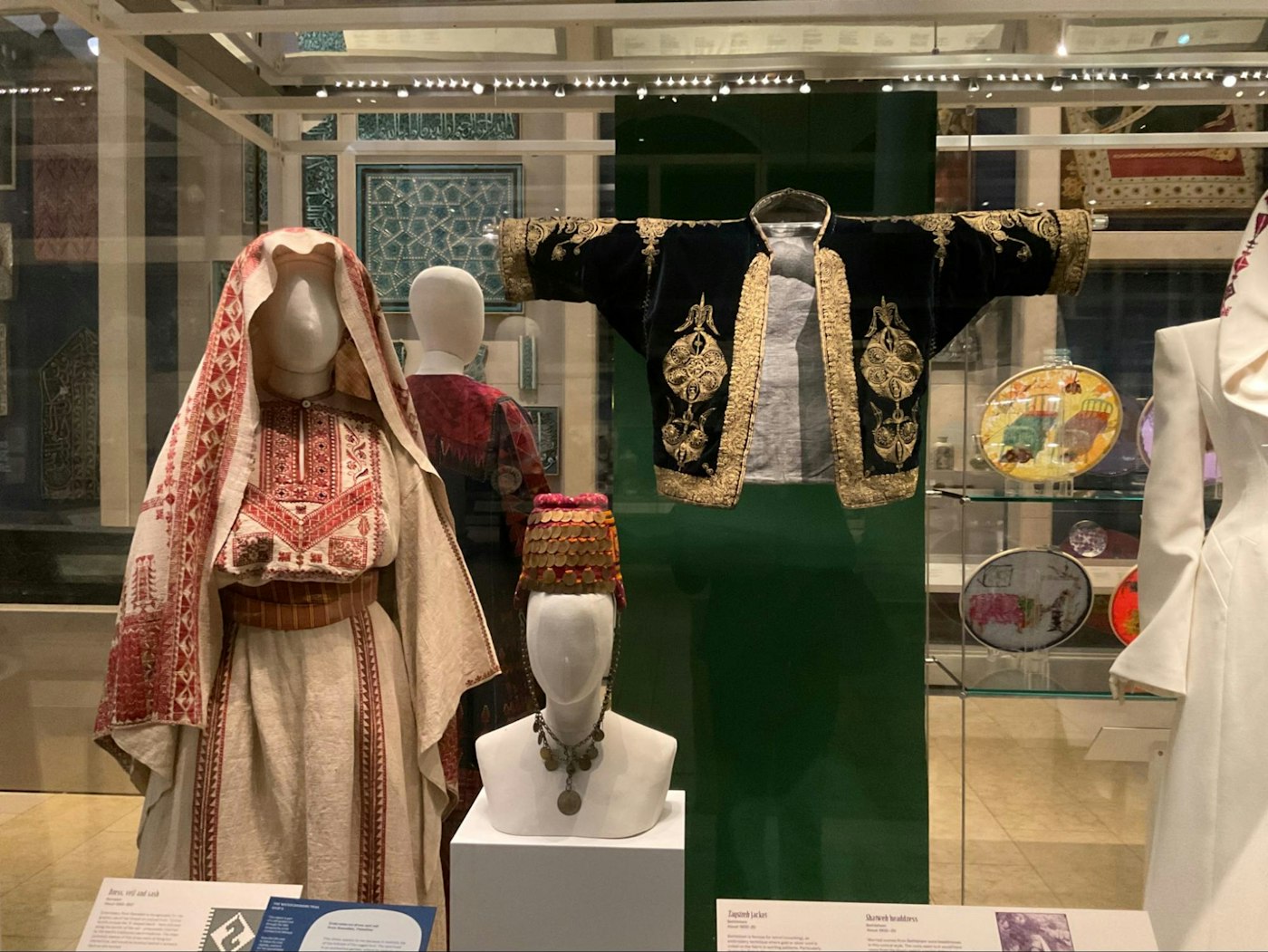

Rachel Dedman was a speaker at last month’s Talking Tatreez event, who focused on embroidery and weaving in Gaza specifically, “because Gaza was a centre for weaving in Palestine,” she asserts.
Crucially, her work unpacks how “Gazan men play an incredibly important role in the dress that we know today, because they wove the fabric that is so iconic” – a conversation feels vital at a time like this, when Gazan men are being vilified and erased by the mainstream media.
Dedman has been working on tatreez for over 12 years. Before joining the V&A, she was an independent curator in Lebanon and Palestine, where she worked on tatreez exhibitions for The Palestinian Museum, in the West Bank. Like tatreez, her work has also evolved. She worked on various embroidery projects across the UK in areas like Cambridge, London and Dundee, all of which highlight the current significance of tatreez through contemporary artists’ work.


Dedman says, “It’s important that we understand and appreciate what is threatened by destruction.” She believes that Palestinian garments covered in tatreez are the signs of love and loss, and “learning about Palestinian culture through dress is a kind of intimate way of connecting with the people that deserve our solidarity, our support [and] active resistance in the present.”

This is an image of a child’s dress that was blown up onto a rooftop in Gaza, which is now on display at the V&A Dundee. “It has the marks of bleaching from the sun, weathering from the rain, [and] the marks of bombardment and shrapnel,” says Dedman.
“It carries the history of what’s happening and tells the story of the genocide and symbolises hope, resilience and the indestructibility of the Palestinian people.”
Palestinian dress historian, researcher and author, Wafa Ghnaim, learned Palestinian embroidery from her mother, award-winning artist Feryal Abbasi-Ghnaim, who learned the art from her mother and grandmother.
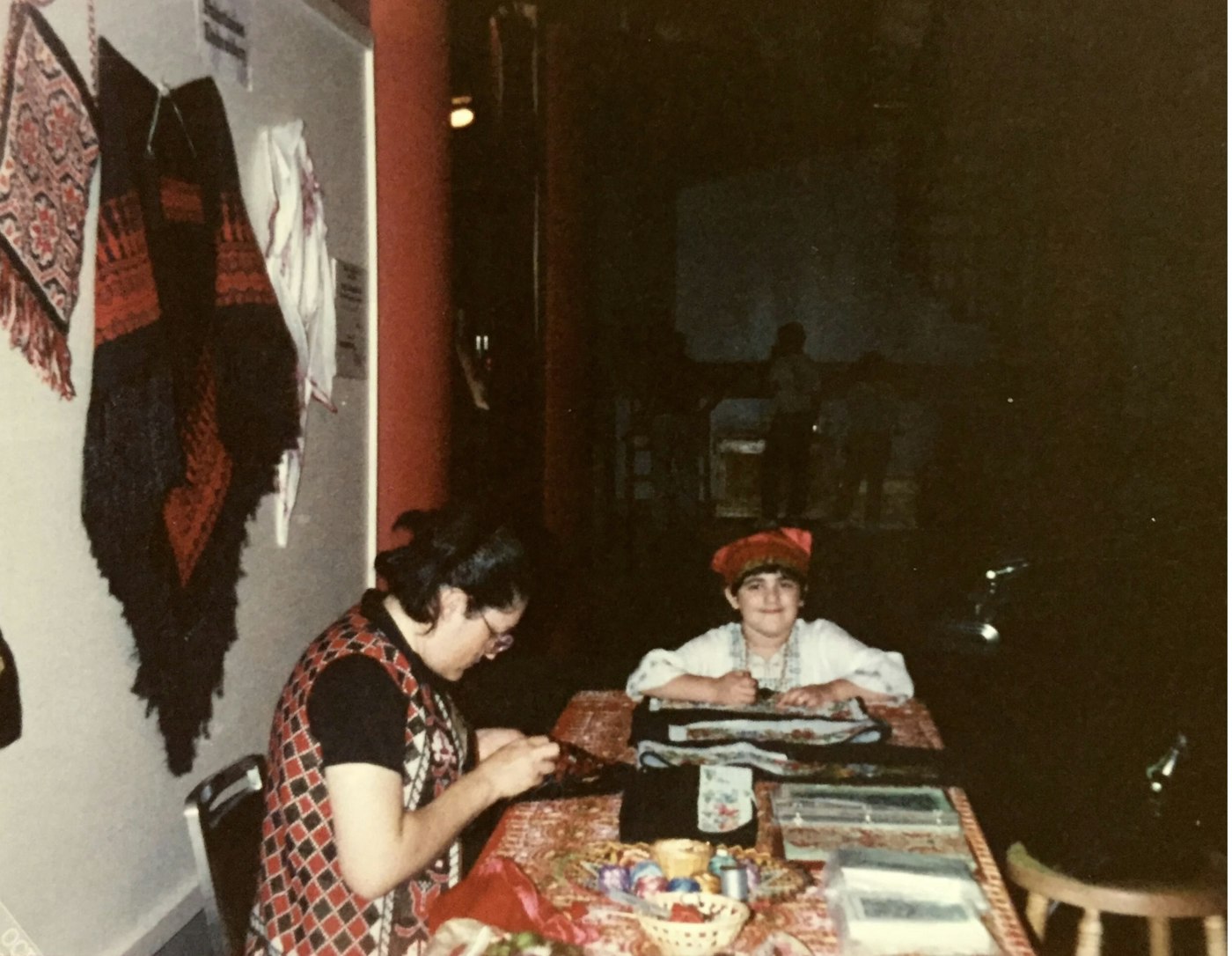
Ghnaim will be speaking about her study of Palestinian headdresses. Ghnaim has a particular curiosity for Palestinian headdresses, which began when she read Hanan Munayyer’s book, Traditional Palestinian Costume, during her fellowship at The Metropolitan Museum of Art, New York. Her research into the traceable origins of Palestinian headdresses was so extensive that her fellowship became a scholarship. “Since then, I’ve been gathering data in terms of different headdresses and coins, to bridge together a theory around their evolution.” Ghnaim has made this her life’s work, which she believes is the way “to understand Palestinian culture when all else has been destroyed.”

Stitching Knowledge from One Woman to Another
Ghnaim also continues her mother’s legacy of teaching tatreez.
“I had no idea that so many people, Palestinians in the diaspora, didn’t know how to do embroidery. I started teaching because people asked. I could count on one hand how many people were teaching it; it was very inaccessible, and so my goal [became] to universalise the knowledge of Palestinians in the diaspora.”
“Embroidery is ever evolving,” says Ghnaim. She thinks it’s important for people, Palestinian or not, to “learn about what our lives create, not just our deaths,” and one way to do that is through “Palestinian embroidery and dress.”
Ghnaim believes that Palestinian women have maintained an incredible legacy of visual language, technique and style throughout centuries. “To me, that’s so tremendous and so much more beautiful of a contribution to humankind, and that makes me proud.”
Halima also teaches tatreez, which she learned from tutorials and her mother’s guidance. She began teaching because people started to wear Palestinian clothing, but didn’t understand the meaning behind it. “First through invitations from universities and galleries across Germany and most recently at a museum in Hamburg, where I not only teach the stitching techniques, but also share the cultural significance, origins, and evolution of tatreez,” says Halima.
Tatreez in Our Future
There is a range of various tatreez motifs, including doves, watermelons and cypress trees; however, Ghnaim wants to see patterns of rubble and rocks, “motifs around the destruction of what we’re seeing with current warfare today.”
Those who want to learn tatreez should “Go for it,” says Halima. “You can stitch it onto almost anything – shirts, tote bags, accessories – making it a versatile and creative practice. It’s a way to express yourself artistically while also carrying forward a piece of Palestinian heritage.”

Why not take a look at whether there are any exhibitions or workshops on the artistic and intimately political tradition of tatreez happening near you this winter, or check out one of the many tutorials available online? And perhaps consider taking up the practice yourself as a form of resistance and an embodiment of what Wafa Ghnaim says, that it’s not just Palestinian deaths that matter, but lives too.

Zainab Patel
Zainab Patel 19 years old London, UK Muslim Produces written & video journalism on topics she believes matter. Her interests include: Reading, writing, sewing & travel.
