
Welcoming Little Ones: Making Space for Play in the Masjid
by Raiyana Malik in Culture & Lifestyle on 8th April, 2026

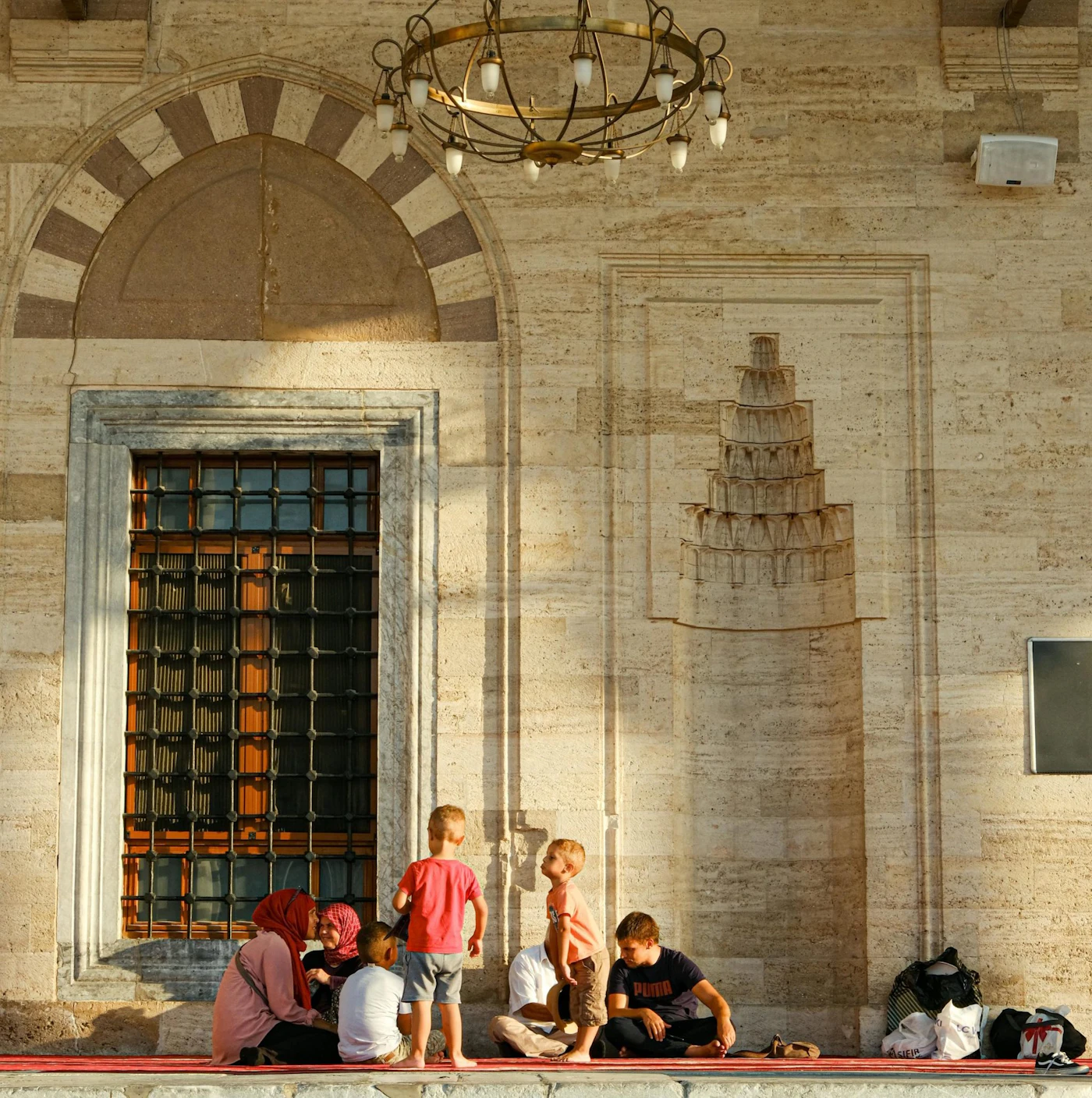
The importance of nurturing children in a welcoming masjid environment.
“I’m so late,” I mumble under my breath as I sprint up the stairs towards the sisters’ side of the masjid, slipping off my shoes and smiling at the volunteers. On my way up, I pass two little girls sitting at the bottom of the steps, their tiny hands wrapped around paper cups of lukewarm chai as they giggle and try not to spill their refreshments.
Inside, the overhead fluorescent lights are off, and the soft glow from the string lights floods the musallah. It’s much later in the night now, and only two full sufoof (plural of saff) remain in the large prayer space. I pray Isha and then hurry over to join the jamaat and slip into line as taraweeh continues.
The qari’s voice fills the musallah as the congregation stands shoulder to shoulder in prayer. The carpet beneath our feet is soft, dotted with fallen abaya sequins and beads that catch the light.
As I focus on the verses being recited, I’m momentarily distracted by a soft whisper behind me.
“Do you want to race?”
Children dart back and forth across the empty sufoof behind us, their footsteps soft against the carpet but impossible to miss. I half expect someone to turn around and shush them. No one does. The prayer continues uninterrupted, the rhythm of recitation weaving seamlessly with the quiet sounds of childhood. Rather than irritation, I feel my heart soften. I refocus on the prayer, smiling on the inside.
The masjid, after all, is the heart of the community. And a heart that beats with children’s laughter is very much alive.
In today’s political climate, this role becomes even more significant. For many Muslims living in societies where Islam is often misunderstood or viewed with suspicion, the masjid serves as more than just a place of worship; it’s a sanctuary of identity. It’s one of the few spaces where Muslims can exist unapologetically, surrounded by a shared sense of belief and belonging. Ensuring that children feel welcome in these spaces is not just about comfort; it’s about grounding them in their identity, giving them a sense of pride in their faith, and countering narratives that frame Islam as something foreign or unwelcome.
Ramadan nights at the masjid often become the setting of many core memories for children.
Long after the fasting and late nights fade into adulthood, many Muslims still remember the feeling of being small in a space that suddenly seemed so big: the hum of recitation, the warmth of familiar faces returning every evening, and the excitement of staying up past bedtime.
At my local masjid, after the first four rak’at of taraweeh, the Imam pauses to offer a short reflection connecting the verses recited to everyday life. Before beginning the next set of prayers, he quizzes the congregation with a few trivia questions. Children’s hands shoot up eagerly.
When someone answers correctly, he tosses a piece of candy their way (don’t worry, the Imam also poses questions to the sisters’ side, and a volunteer has a microphone and a bag of candy ready to go!). More often than not, the candy ends up flying in every direction, showering the children sitting nearby. In that moment, the musallah sounds less like a dignified prayer hall and more like a playground. Laughter, excitement and wrappers crinkling in the background.
During the very final nights of Ramadan, after the Qur’an has been completed in taraweeh, the community invites young boys, some barely seven years old, to lead portions of the prayer. Huffadh-in-training stand where elders usually do, their voices slightly nervous but steady. The room listens with quiet pride.
These are the moments children carry with them into adulthood.
Modern life, particularly in Western, productivity-driven societies, often leaves little room for children to simply exist as they are. Public spaces are increasingly designed around efficiency, quiet and control—where noise is discouraged, movement is restricted, and children are expected to behave like miniature adults. The old saying that “children should be seen and not heard” still lingers in subtle ways. Whether on aeroplanes, in restaurants, or even in shared public spaces, expressions of childhood, especially loud or playful ones, are often met with frustration.
In many ways, childhood itself is treated as an inconvenience rather than a natural and necessary stage of life. For many families, this means there are fewer spaces where children are truly welcome to be themselves without fear of judgement.
The masjid, then, holds the potential to be something opposite: a space where children are not just tolerated, but embraced as an essential part of the community.
Islamic tradition has never treated children as unwelcome disruptions to sacred space. In fact, at a time when modern society often frames children as inconveniences, the sunnah offers a completely different model: one rooted in compassion, patience, and gentleness towards our youth. As Muslims, we’re not meant to adopt the harshness or rigidity of a culture that prioritises order over compassion. Instead, our tradition calls us to create spaces that reflect care, flexibility, and an understanding that children are not separate from community life, but integral to it.
The Prophet Muhammad ﷺ once shortened a prayer after hearing a baby crying, explaining, “Whenever I start the prayer, I intend to prolong it, but on hearing the cries of a child, I cut short the prayer because I know that the cries of the child will incite its mother’s distress.” (Bukhari)
In another narration, he prayed while carrying his granddaughter Umamah, placing her down gently during prostration and lifting her again when he stood. (Bukhari)
Perhaps most famously known, it was narrated from Abdullah bin Shaddad that his father said,
“The Messenger of Allah ﷺ came out to us for one of the nighttime prayers, and he was carrying Hasan or Husain. The Messenger of Allah ﷺ came forward and put him down, then he said the Takbir and started to pray. He prostrated during his prayer, and made the prostration lengthy.” My father said: “I raised my head and saw the child on the back of the Messenger of Allah ﷺ while he was prostrating so I went back to my prostration. When the Messenger of Allah ﷺ finished praying, the people said: “O Messenger of Allah ﷺ, you prostrated during the prayer for so long that we thought that something had happened or that you were receiving a revelation.’ He said: ‘No such thing happened. But my son was riding on my back and I did not like to disturb him until he had enough.’” (Sunan an-Nasa’i)
These stories reveal something profound: children were not excluded from sacred spaces in the earliest Muslim community. They were a part of them, and their presence was accommodated with patience and mercy.
The Qur’an itself repeatedly reminds believers of the importance of nurturing the next generation, for example, “Our Lord! Bless us with pious spouses and offspring who will be the joy of our hearts, and make us models for the righteous.” (Surah Al-Furqan 25:74)
The well-being of our children, both spiritual and emotional, is deeply tied to the environments we create for them.
Yet, in some masajid today, children are often treated as inconveniences. Strict expectations of silence and stillness can lead to shushing, disapproving looks, or even outright scolding directed at parents and their children.
While the intention may be to preserve the sanctity of prayer, the unintended consequence can be something else entirely: children—and often their mothers—begin to feel that the masjid is not a place for them and might turn away. For many new mothers, especially those with young or energetic children, the masjid can be one of the few spaces for both spiritual renewal and social connection. Yet, when children are unwelcome, their mothers are indirectly excluded, too. At a stage of life that can already feel isolating, being made to feel out of place in the masjid only deepens that distance from community and faith.
What kind of relationship with faith are we nurturing when a child’s earliest memories of the masjid are defined by embarrassment or fear?
I remember visiting a local masjid as a child that was particularly strict on the sisters’ side. I was around nine or ten years old, attending Jummah with my grandmother. That day, my mom had dressed me in loose jeans and a long sweatshirt dress that fell to my knees—modest clothing for a child who had not yet reached puberty! Still, a woman overseeing the prayer space pulled me aside, rather loudly, and insisted I wear a skirt before praying.
I remember feeling small and self-conscious, suddenly unsure whether I belonged there at all. My grandmother reassured me and stood her ground against the sister who kept justifying herself, but the moment lingered. That masjid is specifically tied in my memory to that uncomfortable interaction. It’s been years, and I still remember all the details of that afternoon so vividly.
But not all of my early masjid memories felt that way. Growing up, my siblings and I often went to the masjid with our grandparents during Ramadan. We would stay for all twenty rak’at, sometimes praying, sometimes sitting quietly, but always present and observing. The aunties and uncles knew us, smiled at us, and encouraged us in small, gentle ways. My grandmother would occasionally slip me a few dollars for “being good,” a small gesture that made me ecstatic to visit the dollar store.
Recently, my brother reflected on those years and admitted that he doesn’t think he would feel as connected to the masjid today if it weren’t for those early experiences. It wasn’t just about the prayers (or the money), it was about the warmth, familiarity and sense that we belonged there. That feeling stayed with us.
Children remember moments and spaces that make them feel small and unworthy. But just as powerfully, they remember the moments that make them feel seen, valued and loved.
When the masjid becomes a place associated with warmth, encouragement and joy, children begin to connect those feelings to their faith itself.
They return not out of obligation, but out of genuine attachment, carrying that love with them into adulthood, when it becomes their turn to uphold and pass on these spaces.
It’s also important to recognise that children cannot learn the etiquette of the masjid without being present in it. Respect, attentiveness and love for sacred spaces are not instincts; they are taught over time, through exposure and gentle guidance. If children are kept away until they are older, we cannot expect them to suddenly feel comfortable or connected. A love for the masjid is built step-by-step, through repeated, meaningful experiences within its walls.
The kindness of aunties who smile instead of scolding. The excitement of candy tossed into the crowd after taraweeh trivia. The thrill of watching someone their own age lead prayer for the first time.
As the night continues to stretch on and the final rak’at of taraweeh approach, the prayer rows thin once more. Behind the congregation, the children return to their quiet games between the empty sufoof, their laughter echoing softly throughout the musallah.
These children are not distractions from worship. They are its continuation.
One day, inshaAllah, they will be the ones standing at the front of the prayer rows. They will bring their own children to the masjid during Ramadan nights, hoping those spaces feel just as warm and welcoming as the ones they remember.
As another Ramadan has come to an end, it’s worth asking what we can carry forward. How can we continue to make our masajid more welcoming for children throughout the year, not just during the holy month? Small changes can make a meaningful difference: organising child-friendly spaces during Jummah, encouraging volunteers to support parents during busy prayer times, or simply leading with patience instead of frustration when children act their age.
A silent masjid may appear orderly, a space to perfect one’s khushoo in salah. But a masjid filled with the small sounds of childhood—whispers and footsteps, stifled giggles and the crinkle of sweet wrappers—is something even more beautiful. It’s a community trusting its future. And perhaps that’s exactly what the masjid was always meant to be.
A welcoming masjid doesn’t happen by accident; it’s something a community actively chooses to build.

Raiyana Malik
Raiyana is a Toronto-based journalist and photographer interested in storytelling at the intersection of culture, faith, and identity. Her work blends reporting and personal reflection, often exploring memory, belonging, and the spaces that shape how we see ourselves.
