
Arabic Calligraphy: From the Making of Ink to How the Ancient Art Is Brought Into Our Contemporary World
by Zainab Patel in Culture & Lifestyle on 14th April, 2026

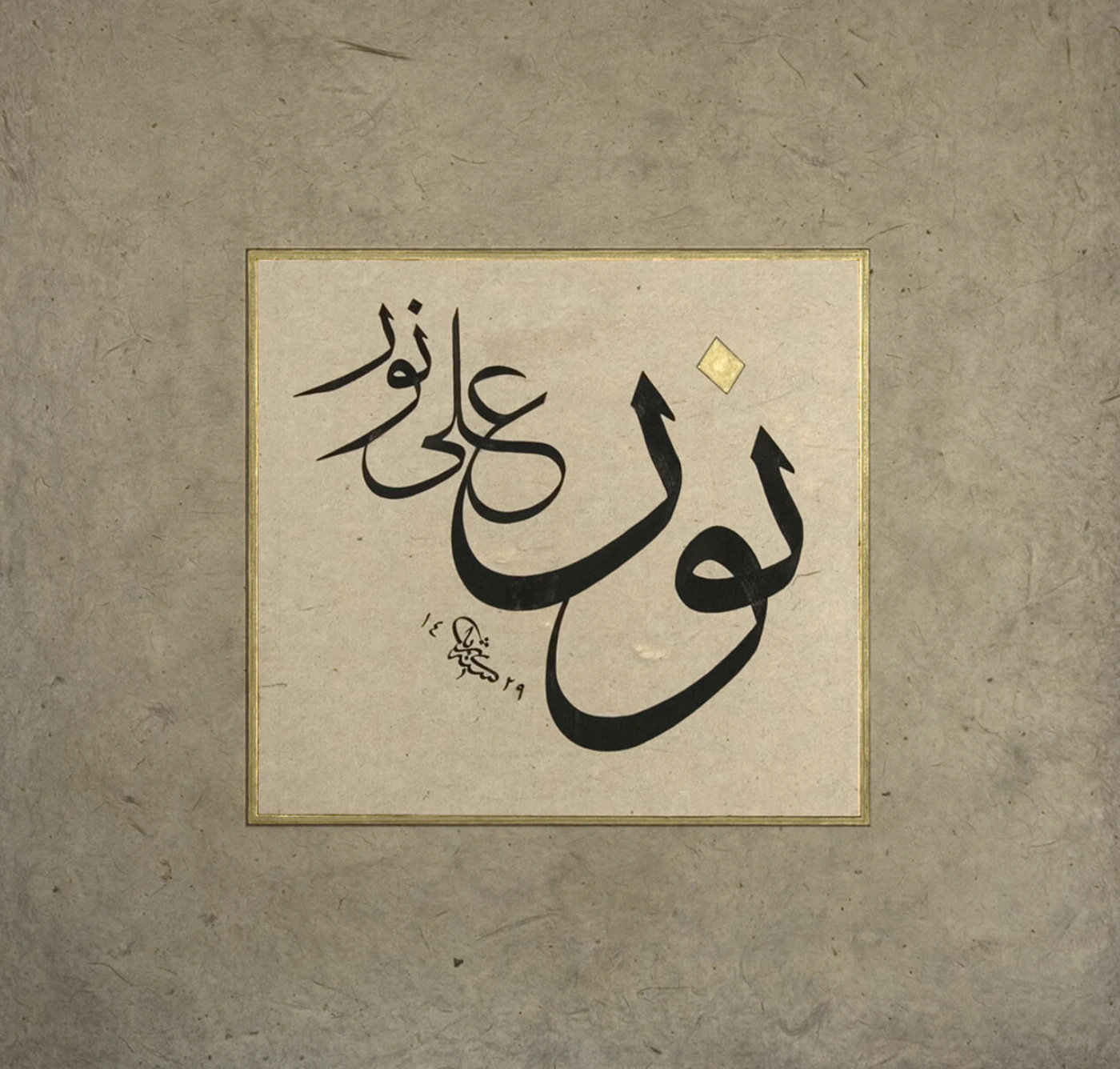
Layered murakka and aharlı-sized papers, inks and crushed moon and red gold leaf
48.5 x 46.5 cm
2008
Muslims around the world make up a rich tapestry of cultures, ethnicities and languages. It’s a community that is widely diverse, spread across the north to the south. Muslim populations fall into over 2300 language subgroups, and whilst only 20% of Muslims are Arab, the Arabic language can be familiar to all.
We are exposed to Arabic everywhere beyond the Qur’an. Through museums and galleries, strangers gather and witness Arabic as a form of art. We decorate our homes with duas written in Arabic, so we remember to recite them everyday. Artists practice Arabic calligraphy and share it with the world through social media, as a way of connecting and bringing together a digital community of both Muslims and non-Muslims alike.
“Arabic calligraphy is a core and deep part of Islam, and it is also a beautiful expression of the Arabic language itself,” says Faizoliya.
She is a British Nigerian artist and winner of the MFAF Youth Creativity & Talent Award, who shares her Arabic calligraphy on Instagram with the hope that people are inspired and are able to resonate with the words of Allah ﷻ through it. “Even if you don’t speak Arabic or are not Muslim, it is still a beautiful art form that has been around for a very long time.” She expresses that the intricacies of Arabic calligraphy alone are enough for anyone to experience its beauty through practice.
Creative History
Many styles of Arabic calligraphy have evolved greatly over time. “One of the earliest and most well-known styles is Kufic, which is more angular and structured,” says Faizoliya. This universal script originated in Kufa, Iraq. It’s a beautiful but unusual style compared to what we often see today, consisting of geometry. However, due to the long time it takes to write in Kufic style, and because it doesn’t fit well on small pages, the Arabs developed their style of writing, such as Thuluth and Diwani.

“What I love is that although time has passed, the key structure and beauty of Arabic calligraphy are still there, while people are able to express themselves in their own creative way,” says Faizoliya.
Qalam
Arabic calligraphy is written with various types of pens, but the Qalam pen, made from a dried, cut reed, is a symbol of wisdom in Islam. In the first ayah of Surah Al-Qalam, Allah ﷻ says,
“Nũn. By the pen and what everyone writes!” (Surah Al-Qalam 68:1)
The pen is associated with writing, learning and following the words of Allah.
Yaqut al Musta’ simi was a famous calligrapher from the Golden Age, and he made a small but life-changing contribution to Arabic calligraphy by cutting the pen nib at a slant. The Golden Age was a time when Muslims, including artists, philosophers and scholars, contributed to cultural, scientific and economic growth. Under a Muslim empire, people from different races and religions, such as Jews and Christians, could come together to express ideas, and women were in working environments such as farming.
It is said that during the Mongol sack of Baghdad, which was the invasion of the capital, its Muslims, and their achievements, Yaqut took refuge in a minaret and continued his work. Many women worked on Arabic calligraphy under him and achieved the intricate skill.
The Colour of Ink
In Persia (Iran), in the 7th century, calligraphers used ‘lamp black ink,’ which was a black carbon coating left on a lamp after it was heated, mixed with gum arabic and distilled water. Gum arabic is the secretion of the stems from an Acacia Senegal tree. Egyptians used it to write the main body of scripts on papyrus in 2500 BCE. It was also the first ink to exist in China and was perfected by the Japanese.

But inks of many colours can be made using natural ingredients from different corners of the world. Former illustrator and now ink maker, Jason Logan, takes us on a journey through his inventions in the film, The Colour of Ink, which features classically trained Arabic calligrapher, Soraya Syed, whose life’s work shows us how the ancient art has evolved beyond pen and black ink.

The Colour of Ink was released in 2022. Based in Toronto, Canada, Jason Logan travels to different places around the world and collects objects such as berries, flowers, shells, rocks and rust and transforms them into ink. He sends the inks to artists and calligraphers in places such as Japan and the UK, so they can try out his one-of-a-kind, unpredictable creations. “I was passing a black walnut tree on my way to work,” says Logan. He knew that ink could be made from this type of tree, and so he put it to the test, and it all stemmed from there. “It was such a beautiful colour to me, and so easy to make the ink. I love the way it smelled, and I love the way it worked.”
He went from using natural materials to whatever he finds at his feet. Referring to his materials as his children, he explains why wild grapes may be his favourite to use. “I just love the way they are another very urban material. They often grow around train tracks, and they pull a lot of stuff out of the soil, so the colour moves around. And purple is such a rich, royal and historical colour.” Wild grapes have many colour possibilities, such as fading under a UV light. It can also turn blue or pink depending on the pH of a paper, and by adding lye or baking soda, it can turn green.
“Colour is a verb; it has no final resting place. It’s a dance of electrons. No matter what, colour is always a movement,” says Logan.

With an interest in the history of Rome, and through a collaboration with artist Marta Abbott, who also features in the film, Logan makes a unique white ink made from marble dust straight from Carrara, a town in northern Italy. Carrara marble is a metamorphic rock, quarried from the Apuan Alps. He sends the marble ink to Arabic calligrapher Soraya Syed, who creates a beautiful piece of artwork with it.


“With Arabic typography and ink, each letter form is also a picture. The sort of Arabic relationship to letter forms and words has a spirit. I don’t know if there’s any other culture that has it in that same poetic, deep way,” says Logan.
More Than a Pen Nib and a Jar of Ink

Soraya Syed is of mixed Pakistani and French origin and focuses on bringing the ancient art of Arabic calligraphy into our contemporary world. She trained under Turkish masters Hasan Çelebi and Efdaluddin Kılıç, and became the first Briton to be awarded the ijazah, a license to practice the art. She has a deep connection to the Qur’an, which shines through her work. What makes her unique is, she incorporates factors such as 3D sculptures and digital media, such as film and VR into some of her work.
Syed worked in Google’s Tilt Brush, to create customised 3D Ramadan and Eid cards in 2018. Tilt Brush is a 3D virtual reality painting app, which allows for a person’s entire room to be their canvas, whilst they create 3D strokes with a headset and controller. She wrote some Arabic calligraphy using this app, and whilst it can have some imperfections, it’s a distinctive concept that is in touch with our digital world.
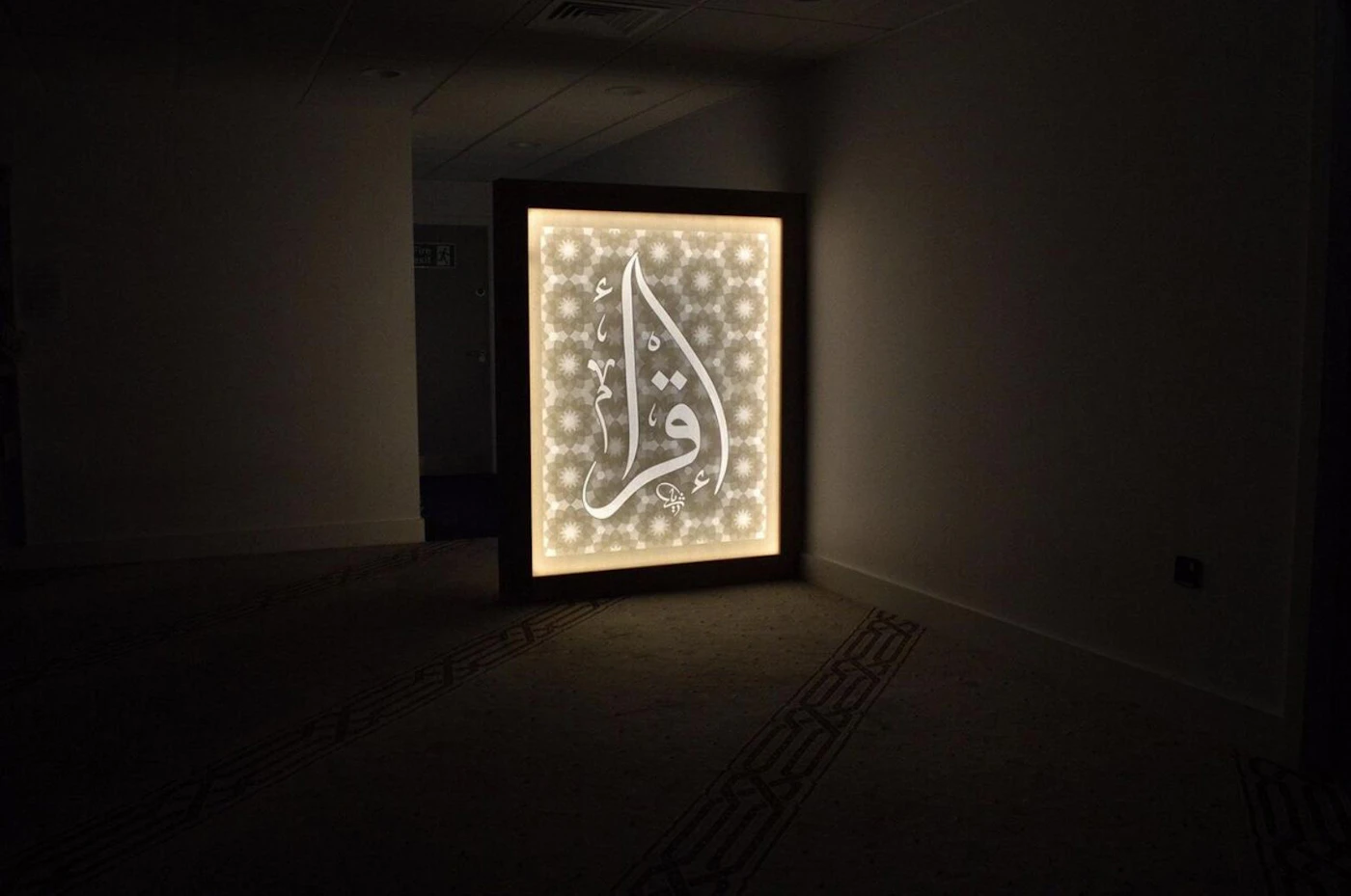
Arabic calligraphy surrounds us more than we realise. This 3D design sits in the female prayer room at City, St George’s University of London.
Syed’s company, Art of the Pen, was hired as an independent consultant to Professor Keith Critchlow and Marks Barfield Architects to provide calligraphy designs for the New Cambridge Mosque. The Quranic verse ‘Qul huwa Allahu ahad’ is embedded in the brickwork that covers the entire mosque in Square Kufic.

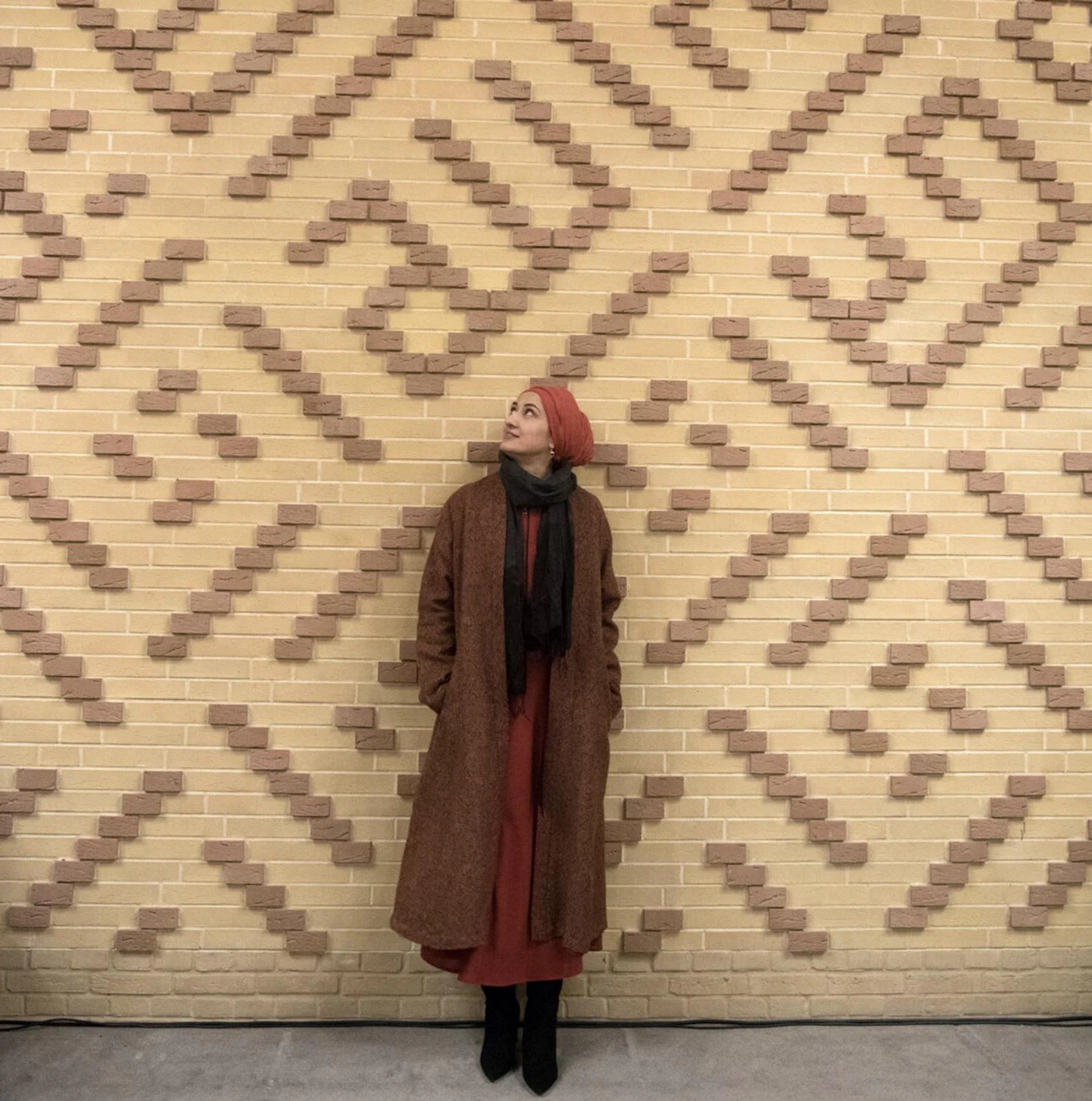
“I discovered Arabic before I knew how to read or write. I was at art school when it really took hold of me, and I think it was from seeing beautiful examples, like at the V&A Museum.” At the time of Syed’s studies, there was little to no social media, and so it was a lengthy process to study and reach the level she is now at. Her advice for people nowadays is to look at social media. “Now there are loads of calligraphers, try and find one that’s professionally trained, so that’s usually a license they’ve been given, so you know that they’ve gone through all of that rigour.”
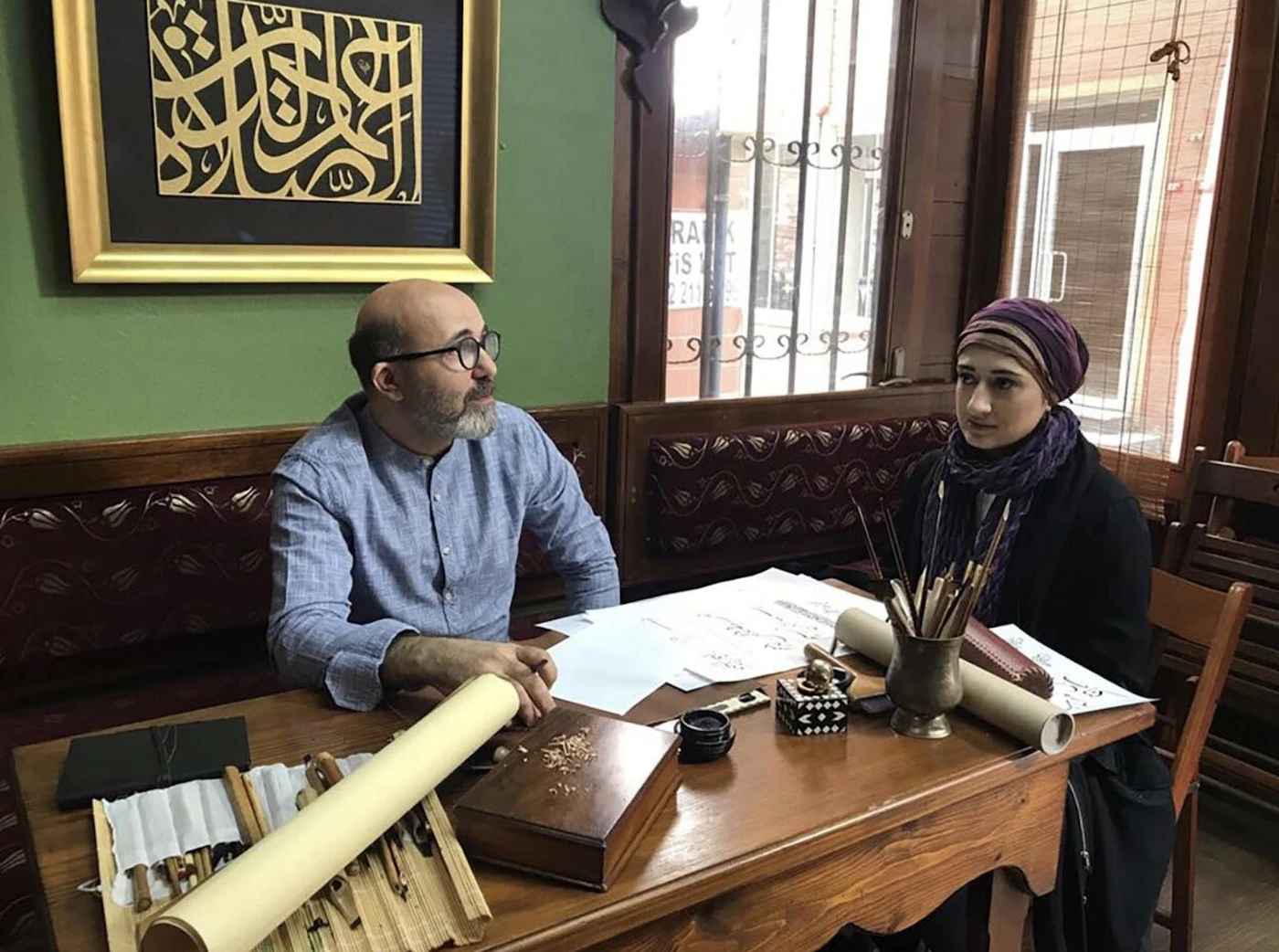
In 2018, Syed returned to one of her teachers, Efdaluddin Kiliç, to show him the workings of Virtual Reality, something that can keep in touch with current and future Islamic artists.
Creating new artistic concepts that fit into our changing lives requires “a genuine place of curiosity,” says Syed. She has “an evolving body of work, stemming from a questioning about the materials that [she uses], and how the materials themselves contain stories,” as they have a “geological history embedded within them,” through sculpture, film and VR aspects, which became an exhibition that first premiered in 2023.
Preservation Today, Tomorrow and Forever
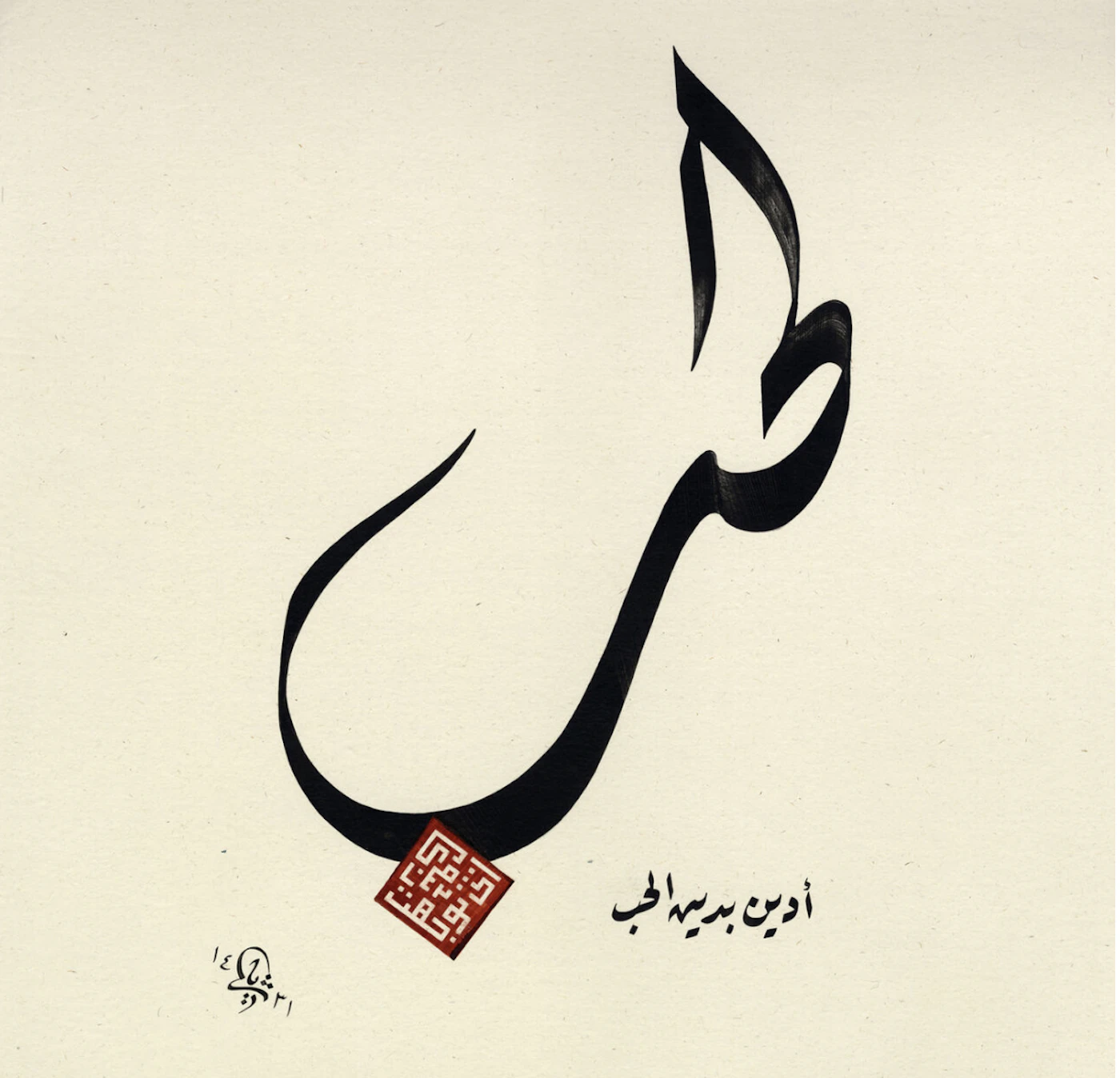
42 x 40 cm
2009.
Courtesy of Soraya Syed, Art of the Pen
Arabic calligraphy has a role in cultural and religious preservation. In 2021, UNESCO added Arabic calligraphy to its Intangible Cultural Heritage list, which protects living traditions. Now, many calligraphy competitions and courses are taking place internationally, and people view it as a practice for inner peace.
“Whether it’s in its sacred form or not, it originates and is deeply connected to the Qur’an,” says Syed. “In terms of its relevance today, it has the capacity, just like the Qur’an itself, to speak to you.”
Due to the many ways that Arabic calligraphy can be applied, it will always speak to new audiences. The first verse of the Qur’an revealed to the Prophet Muhammad ﷺ was “Iqra,” meaning “Read.” In this surah, Allah repeats this twice and talks about the pen in which He taught. “So, from the outset of Islam, the pen is sanctified and is a symbol of knowledge,” says Syed.
Sometimes this life gets ahead of us, and so we find it difficult to put our minds at ease, make time for ourselves and expand our Islamic knowledge. But Arabic calligraphy allows us to do all three. You can write the teachings of Allah simply with household items, like a pen and paper, as a new hobby or calming exercise. So, the next time you’re scrolling through Instagram, take a look at the stunning work of Arabic calligraphers, and have a go at it for yourself.

Zainab Patel
Zainab Patel 19 years old London, UK Muslim Produces written & video journalism on topics she believes matter. Her interests include: Reading, writing, sewing & travel.
