
Football: The Language That Doesn’t Need Words
by Raiyana Malik in Culture & Lifestyle on 15th July, 2026

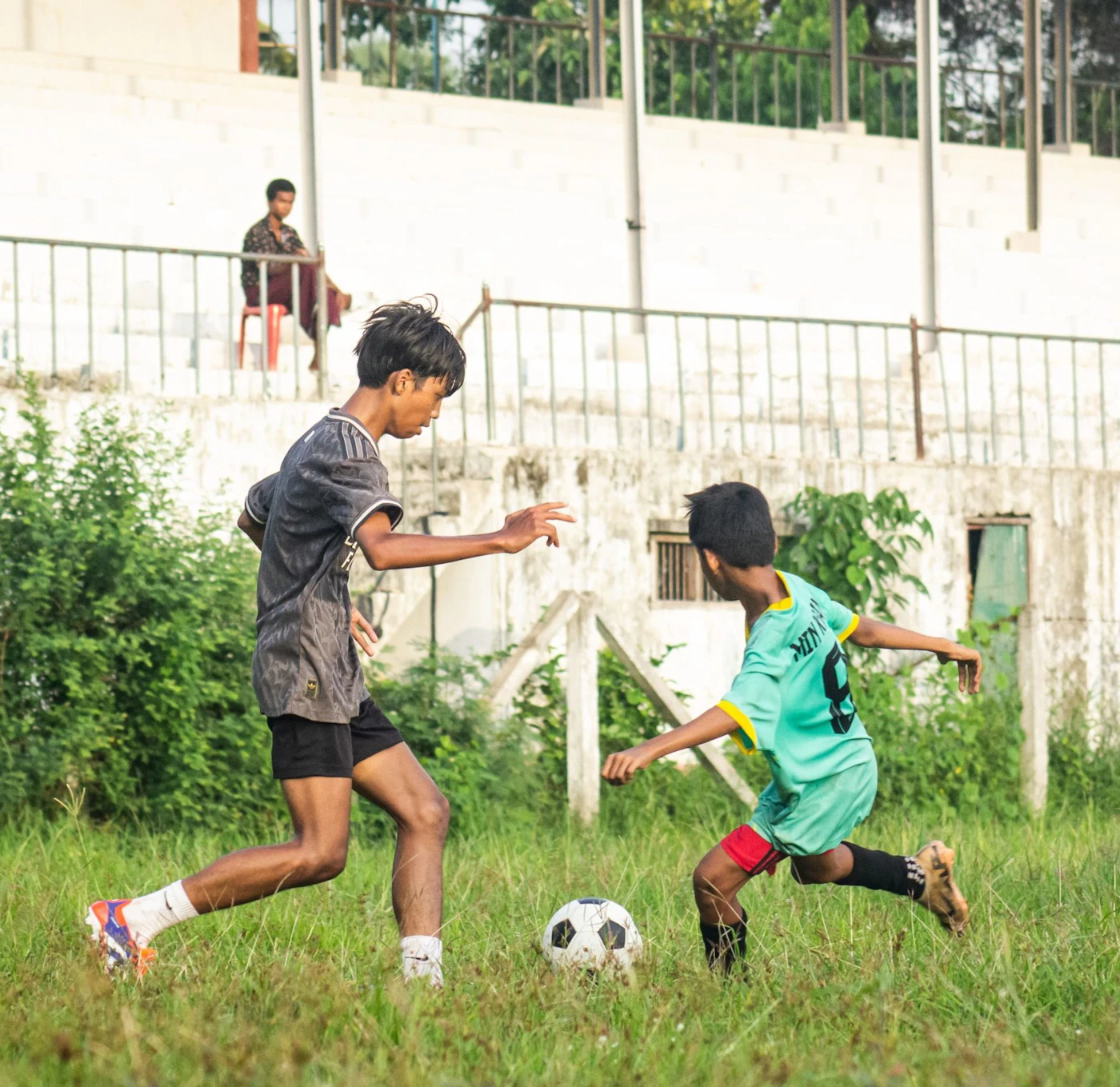
The World Cup may only come around every four years, but the beautiful game has long been bringing people together across borders, languages and faiths.
The only thing I remember from my childhood football career is sitting in a field picking dandelions.
Every summer, my parents signed my siblings and I up for a local Muslim youth football league. Calling me an athlete would be generous. If I was assigned goalkeeper, there was a good chance I would be cross-legged in the grass, completely distracted by flowers growing beside the net while the game carried on somewhere in front of me.

My siblings, on the other hand, loved every minute of it. Growing up in a family that lives and breathes sports, I slowly realised something about myself: I may never love playing them, but I love what they do to people.
Because sports have never really been about winning, they’re about belonging.
And football doesn’t wait around for a tournament to make that happen. It doesn’t need a stadium, a jersey, or a trophy. All it needs is a ball, a patch of open ground and someone willing to kick first.
That’s been true in neighbourhood streets, school playgrounds and empty parking lots long before this year’s FIFA World Cup, and it’ll still be true long after the final whistle blows and the confetti settles. I learned that firsthand as a kid, on a trip that had nothing to do with football at all.
When I was 12, my siblings and I spent a short stretch of a family trip to Pakistan staying with some of my mother’s relatives in Islamabad. My youngest brother was still a toddler then, more interested in wandering off than in games. None of us spoke enough Urdu to even properly introduce ourselves to anyone outside our family.
There was a boy who lived nearby and looked to be around my other brother’s age, a couple of years younger than me. We only played with him once or twice, in the short time we were there. But I remember it clearly, because it required nothing from any of us. No introductions. No shared vocabulary beyond pointing at the ball, laughing and calling for a pass.
We didn’t need to know his name to understand each other perfectly. Looking back, I can’t remember a single conversation we had. I only remember the football.
Just recently, my cousins, whose mom is from Casablanca, visited Morocco for the first time. I went to visit them the night before their trip, and my aunt wasn’t fretting over how they’d spend their days or whether they’d fit in. “I’m sure they’ll play football with the local kids in the street,” she said, matter-of-factly, like it was the most obvious thing in the world.
I asked my cousins about it after the trip. Sure enough, they had. My younger cousin, 11 years old, about the same age I’d been in Islamabad, had spent afternoons playing street football with kids he’d never met before and would likely never see again.
Football has always been described as the world’s universal language. It asks very little of us. You don’t need to share a passport, a first language, or even know one another’s names. You just need to kick the ball.
Football truly is a game that never really stops, and that’s easy to forget once the World Cup takes over. For a few weeks, the world seems to shrink. Neighbours become teammates. Strangers become friends. Entire cities gather around television screens. Family group chats suddenly come alive. Flags appear from apartment balconies, cafes fill before kickoff, and complete strangers begin conversations they otherwise never would have had.
Football’s ability to build community isn’t something that switches on every four years and then goes dormant. It happens constantly, in places far smaller and far less glamorous than a stadium.
It happens after Jummah prayers, when groups of guys still in their thobes head straight from the masjid parking lot to a nearby pitch for a quick game before heading home. It happens during Ramadan, post-taraweeh prayer. It happens in local five-a-side leagues, office leagues, and Muslim youth leagues like the reluctant one I played as a kid — leagues that exist purely because someone in the community decided kids needed a reason to gather every weekend.
It happens for newcomers, too. There’s a reason football is often called one of the last true meritocracies in sport. For refugee and immigrant families arriving somewhere unfamiliar, a football pitch is often the first place where belonging doesn’t depend on fluency, paperwork, or your network; it depends on whether you can play. Nobody on that pitch cares which neighbourhood you grew up in, what your visa status is, or who your parents know. Can you pass, can you run, can you read the game — that’s the only currency that matters.
In a new country where almost everything else asks you to prove yourself through language, credentials, or connections you don’t yet have, football asks only one thing.
You don’t need perfect English or French or Urdu or Arabic to be picked for a team. You just need to show up.
The World Cup didn’t create any of this. It simply makes it visible, all at once, on the biggest stage the sport has.
I’ve been around for six of these tournaments now, though I only really remember 2010 onwards. In elementary school, 2010 and 2014 meant classrooms full of kids buzzing about matches before the bell rang, football being one of those rare things that felt like a genuinely shared language among everyone, not just the Muslim kids or the sporty ones. For reasons I still can’t fully explain, I had a soft spot for Spain back then. I’d never been, still haven’t, though it’s stayed on my travel list ever since.
By 2018, I was old enough to notice something else: how many of the French squad were Muslim, and how “Ramenez la coupe à la maison” seemed to be playing everywhere that summer, a song I still can’t help but think of every World Cup since. And by 2022, I was in university studying journalism, actually covering matches for a broadcasting course, watching the game for the first time as something closer to a job than a pastime. Different tournaments, different versions of me watching, but somehow the pull of it never changed.
Watching this year’s tournament unfold has reminded me why that idea resonates so deeply, and why watching it as a Muslim adds another layer to the feeling entirely. I’m not just watching for the football, I’m watching for something else.
I notice the players making du’a as they walk onto the pitch, and falling into sujood after scoring, pressing their foreheads into the grass in gratitude before thousands of cameras. I notice athletes beginning post-match interviews with “Alhamdulillah.” I notice supporters wrapped in keffiyehs celebrating beside friends from entirely different countries. I notice the joy that spreads across Muslim communities whenever one of our own succeeds on one of the biggest stages in the world.
The passport or the colour of a player’s jersey still matters. But, somehow, it isn’t the only thing that does. The Qur’an reminds us, “‘O prophets!’ Indeed, this religion of yours is ‘only’ one, and I am your Lord, so worship Me ‘alone.’” (Qur’an 21:92)
This verse is addressed to the prophets themselves, reminding them across generations and nations that despite their different peoples, languages, and eras, they belonged to a single ummah bound by the same faith. It’s a reminder that unity in Islam was never meant to depend on geography or nationality. Centuries later, that idea still shapes how Muslims relate to one another. It’s why a Canadian Muslim can feel a genuine, personal joy watching Morocco succeed, or why a Pakistani Muslim can celebrate a win for Cabo Verde’s Muslim players as though it were their own.
There’s a political weight to that solidarity, too, one that’s hard to ignore. Many of the nations that Muslims around the world rally behind — Senegal, Tunisia, Curaçao, Brazil, among others — were, within living memory, colonised: their borders drawn, their languages suppressed, their wealth extracted by the very powers they now sometimes face on the pitch. Football itself spread across much of the Muslim world through colonial administrations, schools, and armies, which makes it a strange inheritance: a colonial export that former colonies have since turned into a source of pride, and occasionally, a scoreboard. When a formerly colonised nation beats a former coloniser, or simply stands shoulder to shoulder with the world’s wealthiest footballing powers, it means something beyond the result.
It’s a reminder that the old hierarchies don’t hold on a football pitch. The ummah cheering together across that history isn’t separate from the political weight of it, it’s layered right into it.
The concept of the ummah asks us to imagine family on a global scale. It doesn’t erase our cultures, languages, or national identities, it simply invites us to see one another through something deeper than borders.
A Canadian cheering for Iran. A Pakistani celebrating Morocco. A Nigerian congratulating Japan. Not because they shared a nationality, but because they recognised something familiar in each other. The World Cup didn’t create those connections, it simply made them visible, which is what football has always done.
Long before sold-out stadiums and billion-person broadcasts, children were kicking battered footballs through neighbourhood streets after school. Parents were cheering from the sidelines of community leagues. Friends were gathering in parks after Maghrib. Muslim youth leagues were quietly building community every weekend, bringing together families who may never have met otherwise.
It’s worth sitting with how far that is from the version of football on display this summer. This is being called the most expensive World Cup for fans in history: official face-value tickets for the final have run as high as roughly $7,800 USD, resale listings have reportedly climbed past $30,000, and some resale platforms have even listed seats for well over $1 million. The players themselves occupy an entirely different financial universe than the kids kicking a ball around after school in the park — Cristiano Ronaldo is reportedly earning somewhere around $300 million this year alone between salary and endorsements, with Mbappé and Haaland not far behind in the tens of millions. Attorneys general in the US have even opened investigations into FIFA’s ticket pricing.
And yet, despite all of that, the beautiful game has always belonged to ordinary people. Most of the Muslims who will feel real, personal joy this tournament will never sit inside a stadium, let alone afford a final ticket. They’ll watch from a living room, a masjid common room, a phone screen at work.
The game FIFA sells, and the game that actually builds community are increasingly two different things.
And it’s the second one that this piece is really about. Perhaps one of the images that stayed with me most during the tournament wasn’t even from inside a stadium. It was seeing Palestinians in Gaza gathered together to watch the matches despite unimaginable circumstances. In a place so often reduced to headlines about destruction and grief, people still found moments to gather, cheer, laugh, and hope together. This is, in a smaller way, the same thing that happens on ordinary evenings in ordinary places: people finding each other through a shared game, even when they have very little else.
Egypt’s coach, Hossam Hassan, put words to that feeling ahead of his team’s last round-of-16 match against Argentina. Speaking to reporters, he said the suffering of the Palestinian people was a shame on the entire world, and pushed back on the idea that empathy should depend on nationality or background, saying, “Regardless of religion… I am a human before being Arab or anything else.” He pointed out how quickly the world mobilises over cruelty to animals, and asked why the same instinct doesn’t extend to the thousands of people dying daily under bombardment. It was a striking thing to hear at a pre-match press conference, days before a World Cup knockout game, a reminder that for a lot of people around the world, football and Palestine aren’t separate conversations.
Football cannot erase hardship, but it can offer something precious alongside it: community. And sometimes community is exactly what people need most.
Eventually, the World Cup will end, the trophy will be lifted, the confetti will fall, all the stadium lights will switch off, and the world’s attention will move elsewhere. But somewhere, children who don’t speak the same language will still find each other through a football. Somewhere in Pakistan, Morocco, Côte d’Ivoire or Toronto. Somewhere outside a masjid after prayer, or on a patch of dirt during Ramadan, long before the next tournament and long after this one is forgotten. Someone will point toward a ball. Someone else will nod. And for the next ninety minutes, they’ll understand each other perfectly.
Maybe that’s what I admire about football, despite never really playing it myself. Not because it’s the world’s game, though it is that too. But because every time I watch it, whether on a World Cup broadcast or on someone’s phone at the grocery store, I’m reminded that the things capable of bringing us together will always be more powerful than the borders that try to keep us apart.
And for Muslims, perhaps that universal language sounds even more familiar. Sometimes, it sounds a little like the ummah.

Raiyana Malik
Raiyana is a Toronto-based journalist and photographer interested in storytelling at the intersection of culture, faith, and identity. Her work blends reporting and personal reflection, often exploring memory, belonging, and the spaces that shape how we see ourselves.
