

At some point in your life, you’ve probably eaten fried chicken from a box.
Unwrapping a box of golden chicken wings, seasoned with a slight kick, on a bed of steaming double-fried chips is the ultimate comfort food. There’s this particular type of hunger that can only be cured by eating it – well, for me anyway.
And I’m not alone in that feeling. British comedian Mo Gilligan’s recent Netflix documentary, Big Chicken: A Fast Food Conspiracy, captures how Britain became obsessed with fried chicken, from the cravings of customers to the enormous industrial system behind it. He describes the country as having a £12 million-a-day fried chicken habit.
The show follows Gilligan on a 28-day journey to eat fried chicken every single day for breakfast, lunch and dinner. But after 84 meals and nearly reaching the 28-day mark, he’s gained a few pounds and starts feeling fatigued and cranky. In between his investigations, he discovers the racism linked with black people and chicken and the shockingly harsh working conditions many people face whilst working in these industrial chicken factories.
But follow the smell of the fryer into enough of the 6,000 chicken shops in Britain, and you’ll find a significant part of the industry is halal.
Halal is no longer a niche in the UK and has become a mass industrial market. Muslims make up around 6% of the UK’s population according to a 2026 report by the Muslim Council of Britain, and chicken is particularly important. Research revealed by the Agriculture and Horticulture Development Board found that 92% of British Muslims eat chicken every week compared with 69% of the population as a whole.
But what does halal actually mean when the chicken on your plate has travelled through a vast industrial food system?
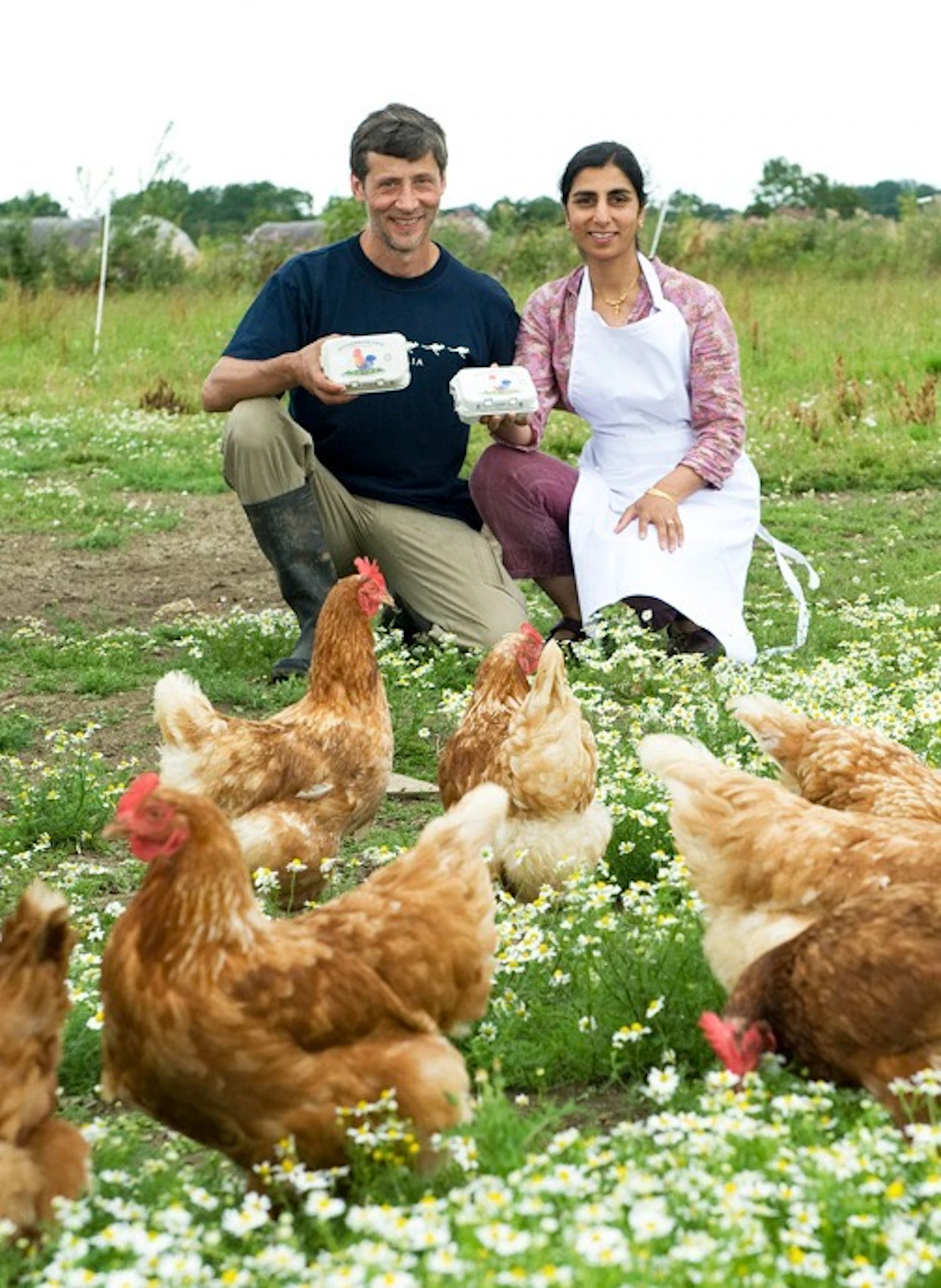
“I remember thinking I’ve eaten a lot of pieces of chicken and still not satisfied,” says Ruby Radwan, who owns Willowbrook Farm with her husband Lutfi Radwan in Oxfordshire.
“It’s empty calories that have no nutritional value, and our bodies notice it.”
Willowbrook’s farming method focuses on slower-growing breeds that reach maturity at 10-13 weeks. Radwan emphasises a natural environment where birds are free-range, allowing for natural pecking behaviours. The farm avoids antibiotics and hormones for all their animals and uses in-house alternative remedies like garlic powder.

“We have a totally different type of chicken called the Cotswold white. I’ve noticed after eating one or two pieces of meat I feel overwhelmingly meatful.”
For the 61-year-old, the low prices at supermarkets and chicken shops often come at the expense of animal welfare and human health. “We’ve had to sacrifice our health and the due diligence and care we should have towards all the animals and the environment that we live in to make chicken so cheap,” she says.
“For selfish reasons, it’s better for me to look after the animals for my personal health. You don’t even have to be Muslim or believe in God.”
In Islam, the concept of tayyib translates to pure, wholesome and clean, therefore, when it comes to halal meat, tayyib encompasses holistic quality and ethical treatment, which Willowbrook adheres to alongside halal.
Halal in Arabic means permissible. It describes things that Muslims are permitted to eat, drink and do in accordance with Islamic principles. For meat to be considered halal, the rules generally require that the animal is a permitted species, it is live and healthy at the point of slaughter, Allah’s name is invoked and carried out by an eligible person.
“We decided we’re not going to go with any certification because they call it halal at the point of sacrifice and not including the life the animal had beforehand,” Radwan tells me.
For Ruby, Muslims should be concerned about the life cycle of the poultry or meat they’re consuming. She mentions that Allah ﷻ has given us these animals as sustenance to help humans survive. The Qur’an states, “They ask you what is lawful (halal) for them. Say, ‘what is pure and natural (tayib) is lawful (halal) for you.’” (Surah Al Ma’idah 5:4)
Food and actions must be both lawful and pure to be fully accepted. Harmful, filthy or unethical things are excluded. But what does evidence say about welfare?
A chicken can be halal, telling you how it was slaughtered, but it doesn’t necessarily tell you how it lived and how it was farmed.
Worldwide, over 70 billion chickens are slaughtered every year. Commercial chickens, such as the Ross Cobb, which dominates the UK poultry industry, accounting for 95% of all chickens produced in the country, are bred for extreme growth speed – usually in four to five weeks – rather than natural movement. Industrial farming leads to unhygienic conditions where waste accumulates because the birds are in confined spaces and can not move around enough, leading to stress, cannibalism and the need for antibiotic use for disease prevention.
Over one billion chickens are produced in the UK each year, with around 96% of these raised in intensive factory farms. These factory units follow a vertical integration model which focuses on high-density broiler production and lowering costs.
Step into your local supermarkets and you’ll find boxes and trays of chicken wrapped in the same transparent plastic and perhaps a sticker to tell you which part of Britain the chicken is from. But what you won’t see is the industrial system that brought them to the fridges.
The latest government data does not give a precise number of halal chickens slaughtered in Britain, but the 2024 Food Standards Agency’s survey found that 88% of halal meat chickens in England and Wales are stunned before slaughter, while around 3% were slaughtered without stunning. Across all animal species, an estimated 214.6 billion animals were slaughtered for halal meat in the UK in 2024.
Clearly, this means a large portion of halal chicken is processed in industrial factories, supplying the rest of Britain’s appetite for cheap meat, raising questions about animal welfare and transparency.
For Radwan, changing the system means consumers changing their habits. She suggests a ‘quiet revolution’ where Muslims could abstain from eating chicken for four weeks.
“All Muslims should stop eating just chicken for Ramadan. If we all do it as an ummah, it could send a massive message out without doing it on the streets in the form of a protest,” she says. “You can make a difference by not buying.”
Her broader message is less about giving up meat altogether and more about eating smaller quantities of better quality meat more consciously.
Halal chicken matters to anyone who cares about transparency in food, the ethics of slaughter and who ultimately benefits from a multi‑billion‑pound market driven by demand for certified meat. Perhaps we should be asking the more uncomfortable questions. One thing we’ve been good at is asking whether something is halal. We should start asking where the chicken comes from and what it costs to put it in the box.
Fried chicken has become shorthand for convenience and ease, a cheap, quick meal that feels comforting. But as Muslims, convenience shouldn’t be the only consideration. Islam teaches us to think about our consumption, responsibilities and the consequences of our choices. Our duty to consume ethically cannot disappear simply because something carries a halal label.
After all, is this ‘cure for a craving’ really just about a box of wings on a Friday evening, or is it something deeper we should all be looking into?

Nylah Salam
Nylah Salam is a multimedia journalist whose work explores culture, identity, faith and the lived experiences of diverse communities. She is also a broadcaster and presenter and can be found @nylah.says on Instagram.
