
Why There Should Be More Muslim Playwrights
by Khadra Mohamed in Culture & Lifestyle on 30th December, 2025


Writing for the stage should be accessible for everyone – Side eYe wants to be part of the solution.
I was lucky enough to go to a relatively decent secondary school, where annual trips to The Globe and West End theatres were the norm. I was smitten with theatre from the very beginning, but like many others, it felt completely foreign to me. Shakespeare felt like a relic, and even the West End plays that felt more contemporary, like The Curious Incident of the Dog in the Night-time, weren’t anything close to my lived experience.
The world of theatre has changed significantly since I was a teenager, with plays like Peanut Butter and Blueberries by Suhaiymah Manzoor-Khan, Blue Mist by Mohamed Zain-Dada, and Statues by Azan Ahmed centring Muslims who are unapologetically themselves. Rabiah Hussain’s thought-provoking work, Word-Play, is also an excellent example of how our lived experiences as Muslims can result in experimental art that reveals the state of the nation.
It was this same ethos that led to the creation of the Side eYe writers group. Side eYe began as a platform for Black and Muslim creatives, and when the collective started in 2018, the ambition was to work on one play staged as part of the Somali Week Festival. Now, in 2025, we have created a community of Muslim women theatre-makers. And with the writers group, we have aimed to give our community the courage and platform to have their stories told.
Each year, we stage new work as part of the Somali Week Festival, and ordinarily, we issue an open call to find a story written by a Somali woman. But every time we face what is admittedly the best kind of problem, the quality of work is so exceptional that choosing one becomes nearly impossible, and we find ourselves wanting to connect with everyone. Throughout the years, we’ve been approached by many Muslim women who share their writing and express interest in working with us. So we began asking ourselves, why not find a way to spotlight more writers and bring them all into the fold? And from that, the Side eYe writers group was born.

The group began as a way for us to connect with Muslim women from all walks of life and experiences. Some arrived with experience of stage work already, like Amal Abdi, whose one-woman show, Desperate Times, was first staged by Side eYe at Somali Week Festival 2023. Others brought experience from different corners of the theatre world, such as directing, producing or tangential industries like television. Some had already found their place in short story writing, cultural commentary and poetry, joining out of a growing curiosity about playwriting. What united them all was a shared commitment to crafting stories for the stage and a willingness to learn not only from our facilitators but from one another.
Over the span of a year, around 15 of us dedicated a Saturday afternoon every six weeks to the group, with sessions facilitated by accomplished writers and dramaturgs from working-class, Black, brown and other marginalised backgrounds.

Our group members not only learned about the tenets of playwriting and storytelling, such as world-building, character development, dialogue construction and narrative structure – but they also gained access to industry knowledge that is often difficult to obtain. From our facilitators, who included Olivier Award-winners Matilda Feyisayo Ibini and Waleed Akhtar, they learned how to build careers in the arts and how to navigate this industry, which can often feel opaque and inaccessible.
It’s no surprise to many of us that the creative industries are dominated by people from middle-class backgrounds. The Sutton Trust found that young adults from working-class backgrounds are four times less likely to break into these fields than those from wealthier households. A similar report by The Creative Industries Policy & Evidence Centre revealed that 90% of people working across the arts, culture and heritage sectors are white, compared with 80% of the general workforce. We don’t need statistics to tell us what we already know, but it’s useful for industry insiders to be reminded of this disparity.
We are determined to combat these statistics
By creating a writers group at no cost to members, which caters to an element of our shared lived experiences as Muslims, we sought to create a safe space that allowed us to tell stories we’re passionate about. Our goal is to remove barriers to entry – women shouldn’t need to have professional credits or family money to make or work in theatre.
Our group provides members with a space that centres their narratives and does not pander to the white gaze. We have the freedom to pursue the stories that matter to them, and this freedom has taken us in every direction. We’ve seen scripts exploring Islamophobia, the impact of migration, and the insidious reach of misogynoir. In a political environment that is becoming increasingly hostile to us, taking control over our own stories is more important than ever.
We’ve also embraced satire and comedy as a tool to examine the political realities that dictate our modern age, from theatre about politically-motivated abductions to housemates navigating surprise evictions and ill-timed burglaries alongside racism and classism.
This year, our contribution to the Somali Week Festival took a different shape. In previous years, we’ve spotlighted one standout script, most notably Sabrina Ali’s Dugsi Dayz, which ultimately made its way to the Royal Court. Seeing how Dugsi Dayz’ successful Edinburgh Fringe run catapulted Sabrina’s career has only driven us further – what stands between many women and a full-fledged vocation in theatre is the chance to share their work.

We wanted to provide this opportunity to more women, and this year, we chose to platform ten members, giving each the chance to see their work performed on stage. Our final showcases took place at New Diorama Theatre this October, where professional actors brought their words to life. For many, it marked their first professional credit, and we hope it’s only the beginning of the stories they’ll go on to tell.
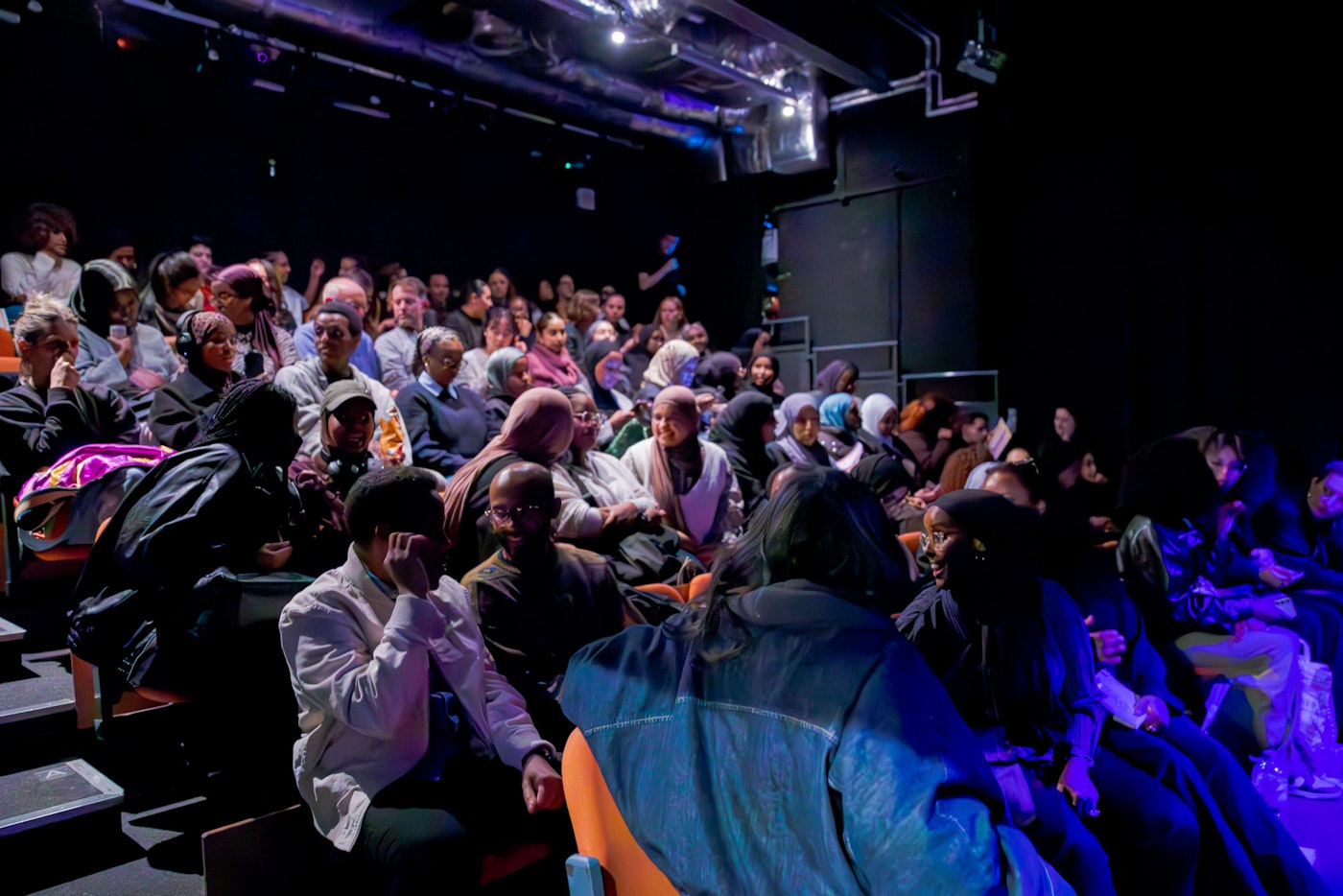
As we look toward next year, we’re hoping to build on everything we’ve learned and continue creating a space where new voices can grow. If you’re someone who has a journal or even a Notes app full of poems, potential plots or stories in your head that you want to develop further, Side eYe would genuinely love to hear from you. You don’t need any experience, just an interest in exploring your voice and being part of a supportive, creative community. We can’t wait to get started.
If the Side eYe writers group sounds like something you’d like to be involved in, you can register your interest and stay connected by filling out this survey.

Khadra Mohamed
Side eYe is an award-winning theatre collective staging stories by Muslims, collaborating with Black Muslim women and their allies. They are drawn to new writing that is witty, absurd, political and truth-telling. Writing that resists pandering to the white gaze and invites audiences to think, feel, and leave changed. Side eYe is more than its productions. They care about what happens outside the theatre, which informs what they do inside it. The collective insists on dismantling barriers to theatremaking by bringing theatre into schools and leading post-show discussions. They run a free all-year-round writers’ group, support new and emerging artists, and have a track record of securing professional careers for those who come through their doors. They also extend their work into film, TV and theatre consultancy. Productions so far include: HOME (2019), Muna Knows It All (2021), Dugsi Dayz (2022) and Desperate Times (2023). Their shows have travelled from local community centres to the Edinburgh Fringe, Somali Week Festival, the Royal Court, Bristol Old Vic and Birmingham Hippodrome. Along the way, they’ve been supported by the Aziz Foundation, Arts Council England, Kayd Somali Arts Culture and their community. Side eYe’s work has been featured in Rolling Stone, Reuters, BBC 1Xtra, Amaliah, The Times and more. Awards include the Edinburgh Untapped Award 2023 and the BBC Popcorn Award for Dugsi Dayz. You can find them on Instagram: @sideye_prods
